

The Community Shield takes place on the 10th of August. The clash between Crystal Palace and Liverpool is just days away, which means that the real action is now just around the corner. The return of Premier League football will see champions Liverpool host Bournemouth on Friday, the 15th of August at 8 pm.
To say Liverpool were surprise winners of the 2024/25 title would be something of an understatement. A poll of 30 BBC experts had seen 19 predict yet another Premier League win for Manchester City. The other 11 all plumped for Arsenal, whilst everyone apart from Fara Williams had Liverpool third or worse.
We won’t even talk about the numerous so-called football experts who had Manchester United, Tottenham Hotspur or even West Ham United finishing in the top four! Football is inherently unpredictable, like all sports. However, it is more unpredictable than higher-scoring ones, such as basketball or even rugby, because just one moment can make the difference between winning and drawing. One mistake, from a player or even the referee, or one moment of extreme good – or bad – luck can swing a game of football.
That makes predicting how a whole season will play out incredibly tricky. It is even harder to do with lots of clubs still seeking to be very active in the transfer market. For example, if Alexander Isak leaves Newcastle and signs for Liverpool, that would have a massive impact on the likely fortunes of both of those clubs.
Nonetheless, at this time of year, many brave punters, fans and pundits put their necks on the line and try to predict how the season will unfold. But one set of predictions that always generates a lot of interest comes from the Opta supercomputer. This might not quite have the power of “the Entity” in Mission Impossible, but it does run 10,000 simulations and look at a huge range of factors.
Opta’s system uses their own bespoke Power Ratings to assess the quality of each side. These are generated using analysis of past results and the strength of the opposition in those games, various xG figures and other analytical stats, plus an assessment of squad quality looking at a range of different metrics.
Throw in a bit of technical jiggery-pokery involving complex algorithms, machine learning, statistical modelling and more, and Opta’s supercomputer is more than happy to spit out all sorts of predictions having run 10,000 simulations of the season ahead. But what does it say?
No Real Surprises

Despite the name, the supercomputer rarely tells us anything too astounding. Generally speaking, the predictions it makes about any given event are broadly in line with what most fans who follow the game would expect. So, for example, last year, like all the BBC experts and most fans who don’t sleep in Liverpool-red pyjamas, it didn’t expect Arne Slot’s men to win the title.
In fact, it gave Man City a more than 80% chance of claiming glory. This time around, things are very different, and it is the defending champions who are expected to make it two in a row. Slot’s men are thought to have a 28.5% chance of doing so, and that figure is higher than for any of their rivals.
We assume that means that Liverpool won the title in around 2,850 of the 10,000 simulations Opta say they ran for this season. They reckon there is a 19.5% chance the Reds finish second, 14.2% third and 10.5% fourth. So that equates to a 72.7% probability Liverpool will make the top four. That said, Everton and Man United fans might cling on to the around 4% chance the Anfield outfit end up in the bottom half!
Arsenal are deemed to have a 24.3% chance of topping the table. While that lags behind Liverpool, Opta make them more likely to finish first than any other position, with second coming in at 18.7%. The same is true of Man City, but things are much closer for them, with the supercomputer rating them an 18.8% chance of being champions and a 17.3% chance of being runners-up.
At the other end of the table, fans of Sunderland, Leeds and Burnley might want to ignore the musings of the supercomputer. It predicts the Black Cats will finish bottom and gives the Clarets the best chance of survival, predicting Leeds will probably finish 19th. It is worth noting, however, that Sunderland are given a 34.1% probability of finishing last, compared to 17.8% and 16.6% for Leeds and Burnley.
That said, according to the Opta stats, fans of those two clubs can take some heart because Leeds are given a 52% chance of finishing outside the bottom three. The figure for Burnley is 54.1%.
There are some predictions that may surprise fans, with Crystal Palace up in seventh according to Opta. That would change dramatically if they were to lose some of their key players, though, and it is hard to imagine them keeping them all. Many will also fancy Man United and Spurs to outperform their Opta numbers, with the supercomputer envisioning minimal improvements this term. It has United coming 12th, with a 6.7% chance of a top-four finish; that percentage is 5.8% for Spurs, who it predicts will finish 14th.
But Time Will Tell
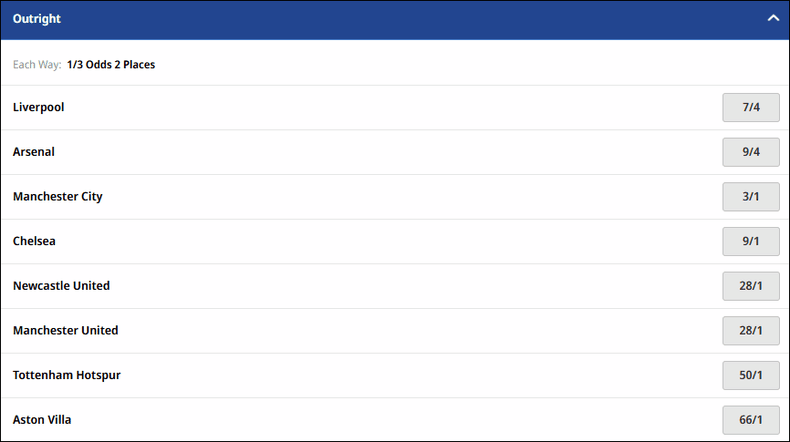
In truth, we would argue that the bookmaker’s odds are probably a better guide to what will happen in the season ahead. The odds and Opta’s view are obviously very similar, but both are simply predictions. Neither can be sure about what will happen and both, fundamentally, are probabilistic views.
If the weather says there is a 10% chance of rain (and therefore 90% chance of it being dry) and it rains, most people bemoan the forecast and say it was “wrong”. However, a 10% chance of something happening is still, really, rather high. Would you fly on a plane that had a 10% chance of crashing?
In short, therefore, take whatever the supercomputer thinks with a pinch of salt. Can it see the future? Absolutely not. However, it can be useful for highlighting certain things and help you think about predictions more clearly. For example, the fact that 19 of the 20 teams won the title in at least one simulation makes Leicester’s “miraculous” win in 2016 a little more understandable. In sport, as in life, incredible, hard-to-believe events will always happen. Let’s wait and see what happens in the 2025/26 Premier League.